
What is the Best Game Show Video Game That’s Not Based on a Real Game Show, and Why is That Game “Lexi-Cross?”
James Key reminisces about the sci-fi-themed game-show-esque DOS game.
In the days before the Internet as we know it, there existed the humble BBS, or “Bulletin Board System.” Using your 2400 baud dial-up modem (look it up, kids), you could connect to one of dozens of local computers sitting in random basements and college campuses. Users could post messages, play games, and upload and download files. Trading files such as text documents, .gifs, and .zip files was commonplace. Piracy? Oh yes, sailing the high seas was as common as firing up TradeWars 2002 in the BBS doors section. As it turns out, I was at one time a co-sysop on “The Pirate’s Bay” (brilliant cover there, guys), and I made a passing comment to the head honcho that I would love a copy of a game I had only seen in magazines… “Lexi-Cross.”
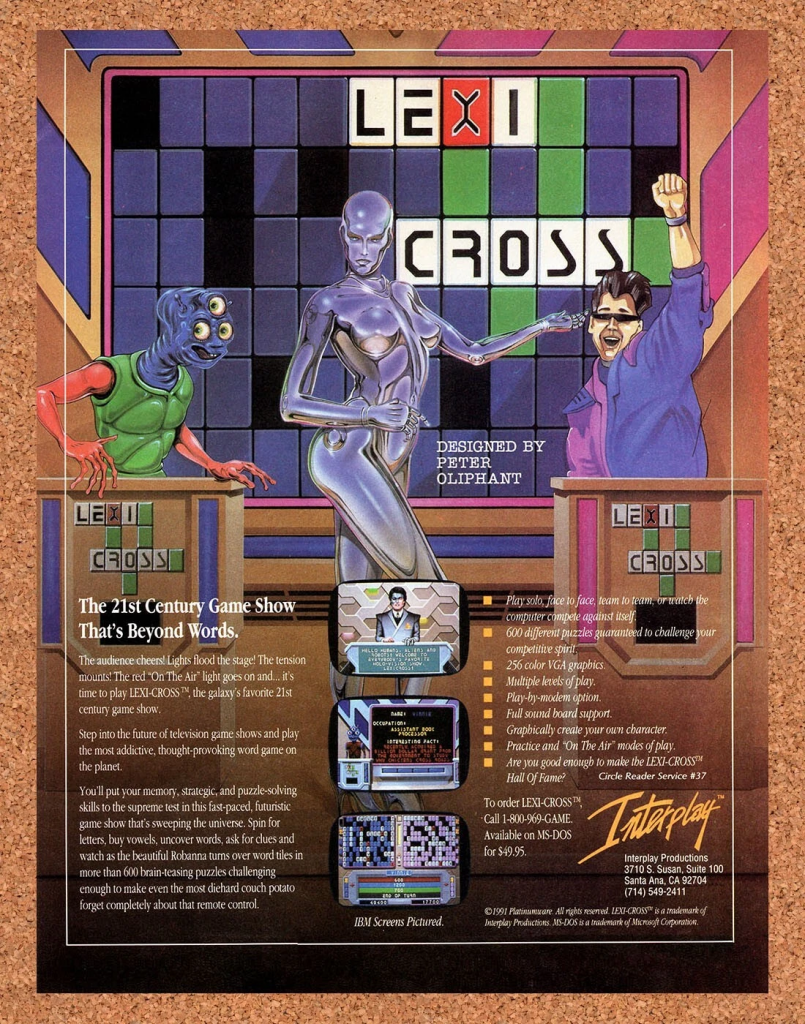
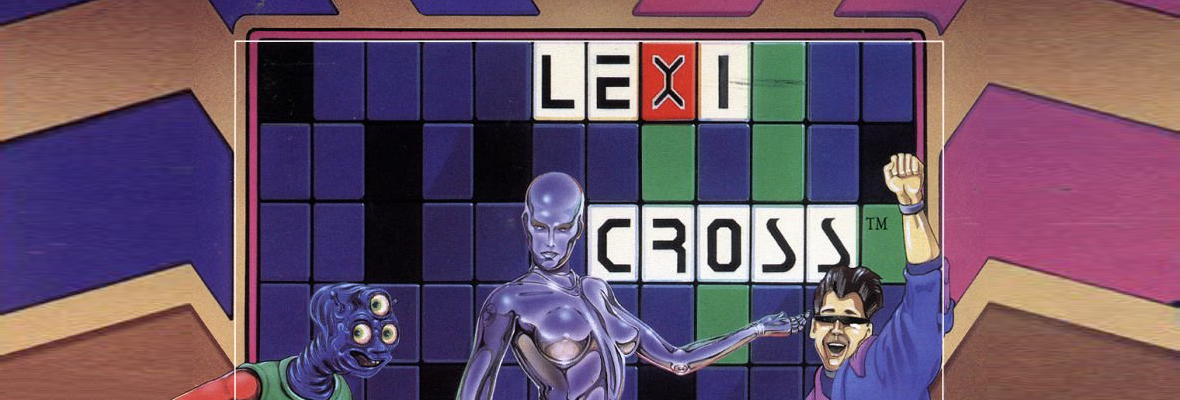
Lexi-Cross, a game available for IBM-compatible and Mac computers, was touted as the most popular game show of the 21st century, destroying all other programs in the ratings on HV (that’s Holo-Vision, it’s 2091 after all). It was developed by Platinumware, and published by Interplay Productions, while Silicon & Synapse (which later became Blizzard Entertainment) handled the Mac port.
I had seen the game available at the mall’s computer software store, “Babbage’s”, but I got sticker-shock. $49.95 was a bit steep in 1991. But my wish upon a BBS came true, and a cracked version of Lexi-Cross was available for download! At 430 kilobytes, the file transfer would take 45 minutes, so I used *70 to turn off my call-waiting, and watched the download trickle onto my 40 megabyte hard drive.
Just to clear my name, I bought a legitimate copy of Lexi-Cross some months later, when I found it at Target in a bin of $5 software boxes. Score!
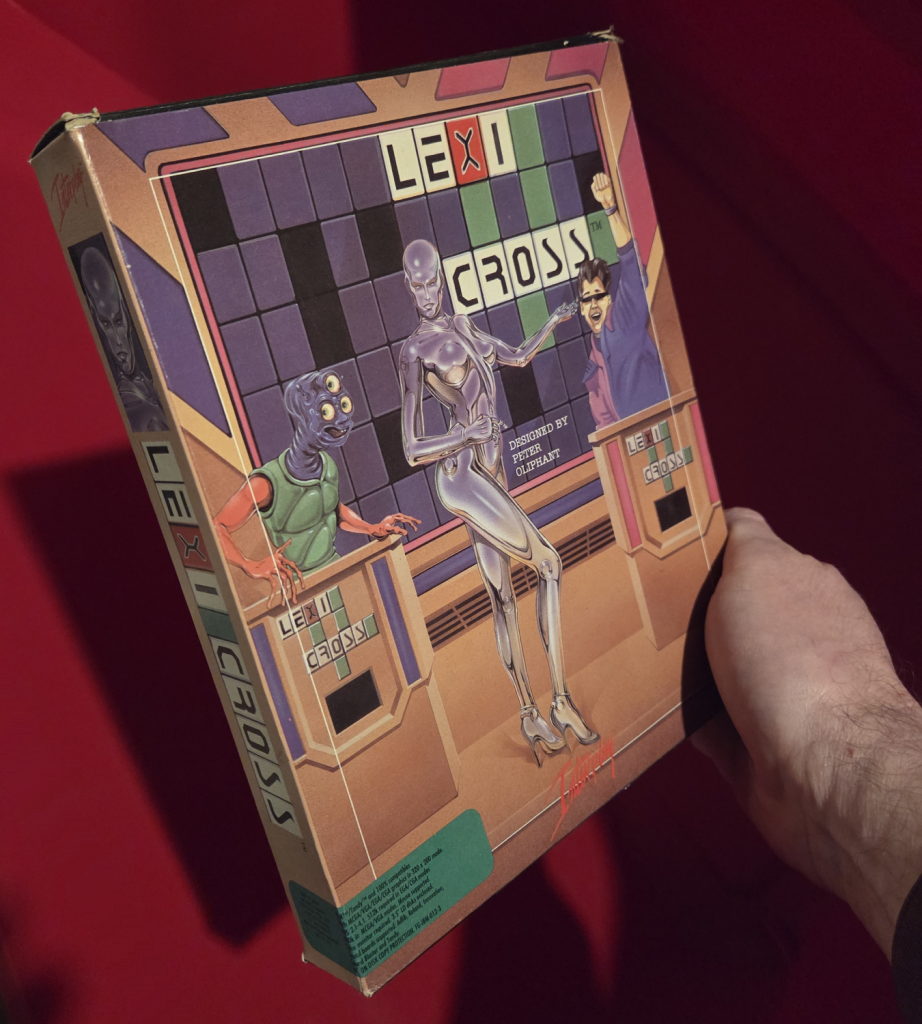
Enough prehistoric lessons! What makes Lexi-Cross the ultimate game show software? Surprisingly, it wasn’t the gameplay, which has its flaws. It was the experience as a whole, which made the player feel like they were on a real game show from start to finish.
The details sprinkled into the game were magnificent to uncover. The very first encounter the player has is with the contestant coordinator, Ms. Pristine Mint. She welcomed you to the studio, took your name and vitals, and walked you through the simple character creation.
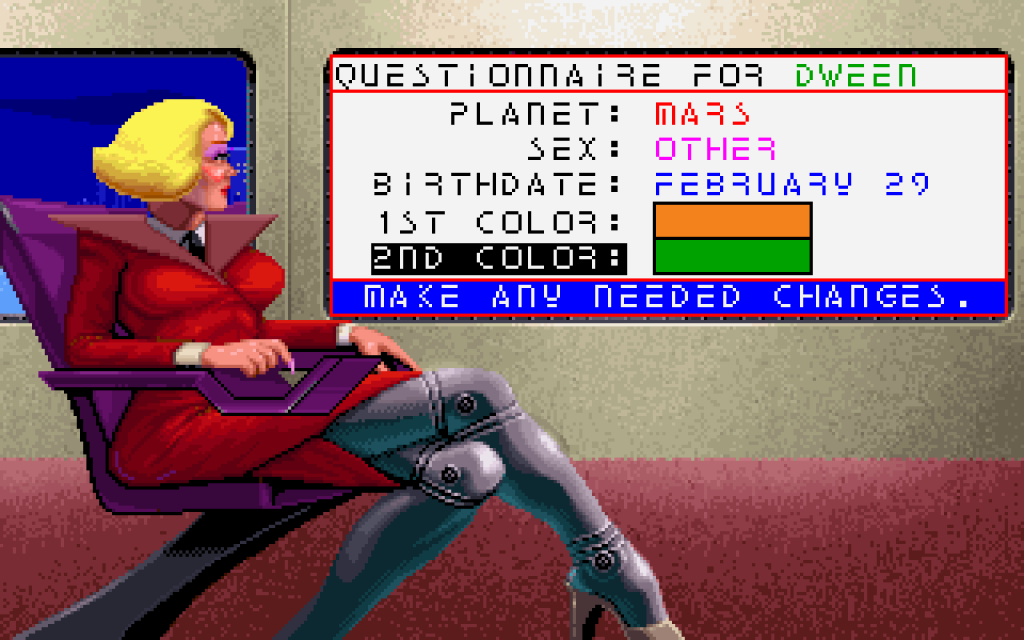
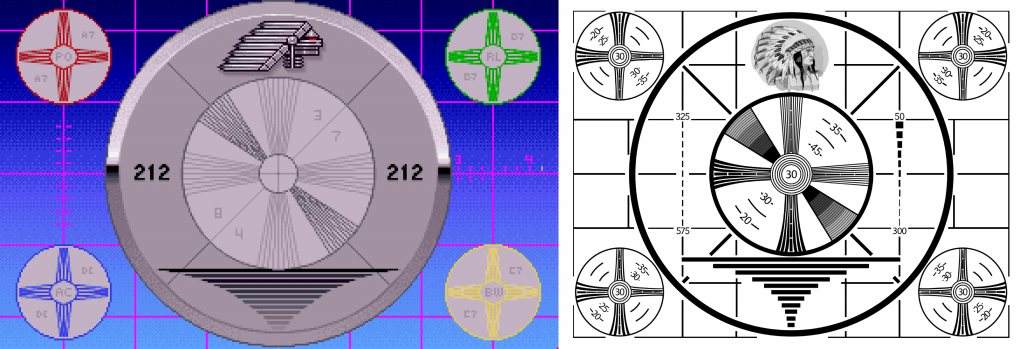
While easy to overlook, it was brilliant that the programmers used the system clock to change the exterior view outside Ms. Mint’s office to match the season and time of day. This level of nuance was splendid to see, and I don’t see it often in modern games. From there, a futuristic version of the RCA Test-Pattern Card was briefly displayed. It’s time to go on the air!
After the game’s title sequence, we are met with a wide shot of the studio, where hovering drone cameras are set to capture the action. One screen wipe later, we meet Chip Ramsey, the cyborg host with a passing resemblance to Bob Goen (or maybe Bert Convy, but it’s a stretch).
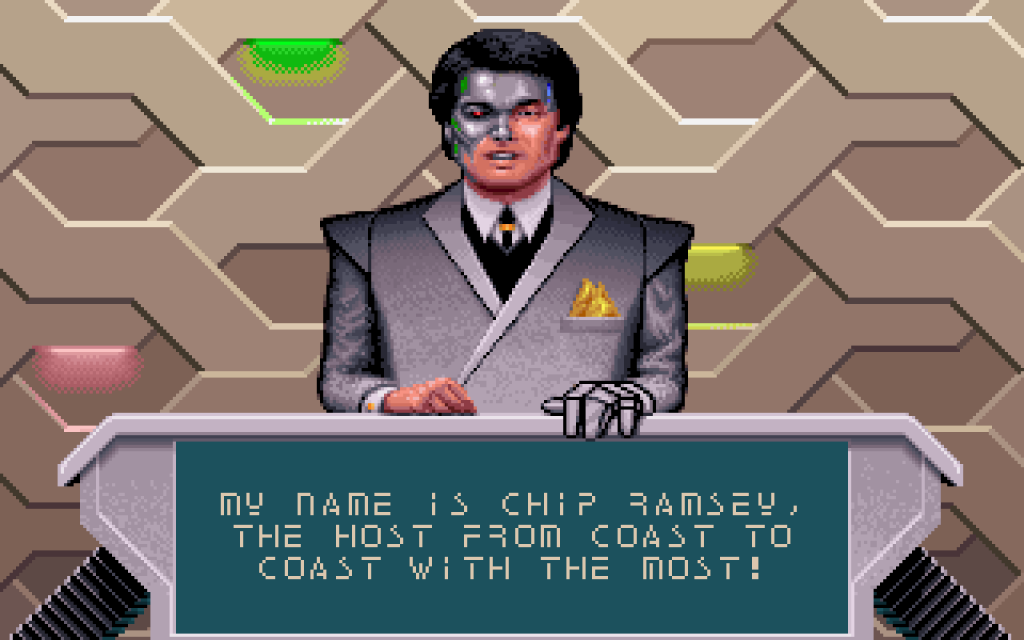
He would introduce the show, using a handful of different quips over the course of multiple games. It was another nice element to keep the game from being too repetitive. A further clever use of the system clock would show up here: If it’s a holiday or one of the players’ birthdays, he would make a celebratory announcement.
As players were introduced, much like any real-life game show, their name, occupation (randomly generated), and an interesting fact (also random) would be given. Honestly, it was a bit of hokey humor that somehow did not get stale. With preliminaries out of the way, the theme song would cue up, and round one would be on tap. It’s a genuinely catchy theme song, even on PC speaker. Later I’ll talk about the composer, George “The Fatman” Sanger.
Here’s where things get divisive. The concept and gameplay are creative, despite drawing inspiration from elsewhere. Sure, it takes “guess the common theme” from Cross-Wits… and the wheel spinning and letter picking from Wheel of Fortune… and the letter values from Scrabble… but it still felt like its own game. Polished in chrome and neon, with 256 vibrant colors in VGA display, Lexi-Cross did a magnificent job of pulling off an original game show idea.
Naysayers will call it derivative. I call it an homage! Critics will say the game is too slow-paced. I say it builds excitement! Sure, one round can take 15 minutes to play… and there are 3 rounds… plus a bonus round… but at least something is happening to advance the game at every moment. Try watching an episode of “Deal or No Deal”, and tell me with an honest face that every moment of that show is riveting. If the game were sped up a tad, it would’ve landed among the greats.
Throughout the game, the host Chip will pop in and give commentary on amazing letter-picks and questionable moves.
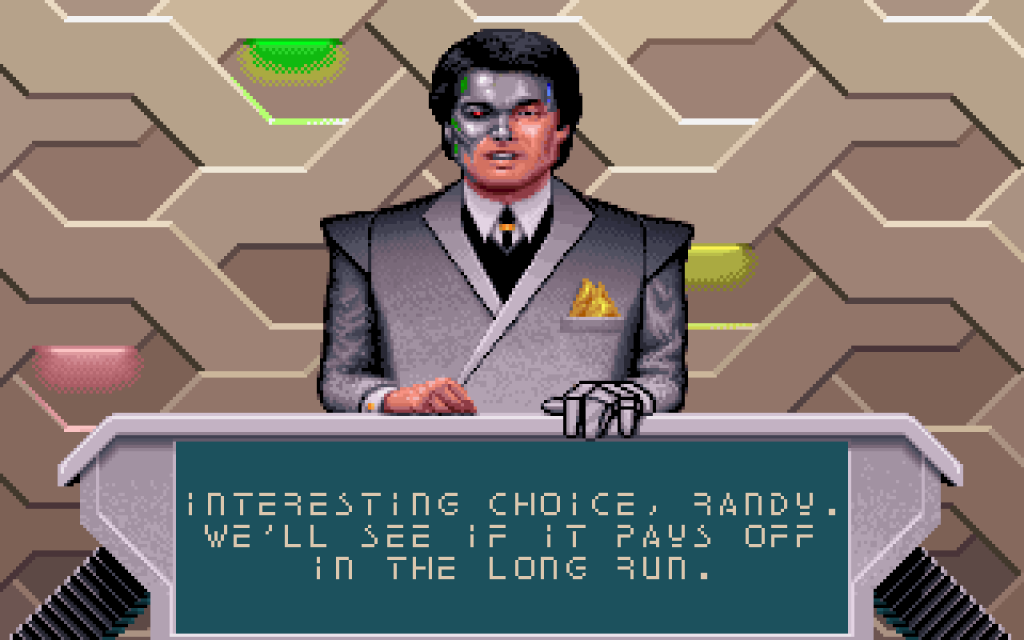
The game oozes with charm and realism. Once all is said and done, the show wraps up with a credit roll with the theme song playing. If the game had been released just a year or two later, maybe they could’ve added SoundBlaster capability, and had actual voice samples, audience reaction, and zippier sound effects. For its time, it was stellar work.
I failed to mention one other aspect that I only noticed when I bought the physical software. It came with a user manual, disguised as an issue of “HV Guide”. It was a 30-plus-page booklet with instructions and tips seamlessly folded into articles, ads, and interviews. In the middle was a spread of HoloVision listings, which doubled as copy-protection. Upon first run of the game, Pristine Mint would “notice” you had an issue of HV Guide, and would ask about a competing program on a certain channel at a certain time. Entering the show name would prove you hadn’t copied the software from a friend. A much more creative method of proof than the standard code wheels, which was the style at the time.

Three big names in game dev were part of the development team. I mentioned George Sanger, The Fatman. He is an award-winning composer for video games with over 150 games to his credit. He has worked on titles such as “Wing Commander”, “The 7th Guest”, and the “Scene It” DVD/board game series.
Peter Oliphant and Rob Landeros were the main co-creators of Lexi-Cross. Peter was a child star (Freddie Helper on “The Dick Van Dyke Show”) who worked at Mattel developing handheld games, before working on software titles like “Defender of the Crown” and “Stonekeep”. Rob also worked on Defender of the Crown, subsequently co-founding Trilobyte games and developing The 7th Guest. This trio seemed to enjoy each other’s professional company.
An attempt to reboot Lexi-Cross was made under the name “Let’s Do Diddley”. This prototype was developed by Digital Circus, which was made up of David Wheeler and Rob Landeros. In this updated version, a few changes have been made. The maximum number of players is increased to three, and there is just one common crossword matrix all players play upon. There are two voice-over hosts, one robotic that deals with number-crunching the scores, and a human voice that keeps players apprised of what’s happening in the game. A new addition to this game is trivia tiles, which allow players to wager on an answer to a trivia question, which also serves as a clue to the overall puzzle. Sadly, there are only a handful of videos that showcase Let’s Do Diddley, and it didn’t seem to make it past the demo stage.
Even with my connections to game show fans in present day, it has been hard to find anyone that remembers Lexi-Cross. It turns out that not only did someone remember it, they developed and released their own updated version on Steam called “Word x Word” (pronounced “Word by Word”). Developed by Ben Hendel-Doying, it’s a cute pixel-art rendition with its own appeal, keeping true to most of the gameplay of the original Lexi-Cross. Things are sped up a bit, which I genuinely find a welcome change. In the original Lexi-Cross, players could find opportunities to reveal an entire row or column as a bonus. In Word x Word, these reveals are removed, instead replaced by “Magnify”, which shows off a 3×3 area of the grid. Diamonds are awarded for brave letter picks, and collecting them can multiply your final score greatly. It’s not as robust a “game show” experience, but the gameplay is solid.
When I get that nostalgic notion to search the Internet for “Lexi-Cross,” I always find a common word used to describe the game: “Underrated.” It didn’t get the widespread popularity it deserved, even in game show circles. In a 2012 interview, Peter Oliphant said, “This is a game I’ve been waiting 20 years to do right, and it seems like a perfect game for cell phones.” He further mentioned Facebook could be a viable platform for a version of Lexi-Cross as well. Ah, what could have been. But the legacy of the original Lexi-Cross, and the pure game show experience it conveys, still shines on in emulation. Pristine Mint is waiting for you.